Food guides · New Orleans
Cajun vs Creole food: the difference in gumbo, jambalaya, étouffée and boudin
I grew up in Breaux Bridge and cooked for twelve years in New Orleans. People still ask me the difference every week. It is easier to taste than to explain, but here is my try.
By Remy Thibodeaux, Host, New Orleans and Cajun Country
· 3 min read
Avery Island, the Tabasco factory Photo: Jan Kronsell, CC BY-SA 3.0, Wikimedia Commons
The short answer my grandmother gave was this: Creole is city food, Cajun is country food. Like all short answers it leaves a lot out, but it is a good place to start, and the two kitchens are only two hours apart by car.

Where the two traditions come from
Creole cooking grew up in New Orleans from the 1700s onward, in the kitchens of a port city ruled first by France, then Spain, then the United States. French technique met Spanish and Caribbean spice, West African cooks who did most of the actual cooking, German farmers upriver and, later, Sicilian grocers. The result uses butter, cream and tomatoes, and it was the food of restaurants and well-off households.
Cajun cooking belongs to the Acadians, French settlers expelled from Canada in the 1750s who resettled on the prairies and bayous west of New Orleans. They were farmers, trappers and fishermen, and they cooked with what they had: rice, pork, game, crawfish and smoke. Cajun food is generally darker, spicier and more rustic, cooked in one big pot.
Gumbo
Both traditions make gumbo, and both start with a roux, flour cooked in fat until it turns brown. Creole gumbo often includes tomatoes and seafood, sometimes okra, and a medium-dark roux. Cajun gumbo is more often chicken and andouille sausage, no tomato, and a roux cooked until it is the color of dark chocolate. In both, it is served over rice, and in Cajun Country often with a scoop of potato salad in the bowl, which surprises everyone the first time.
Stirring a dark roux takes forty minutes or more over a low flame, and it burns in seconds if you look away. Cajun cooks say you should be able to drink a beer while it cooks but not two. Filé, ground sassafras leaves, is the other old thickener, sprinkled into the bowl at the table, never boiled.
Jambalaya and étouffée
Jambalaya is a rice dish cooked with meat and the holy trinity of onion, celery and bell pepper. In New Orleans, Creole jambalaya is red, with tomatoes. In Cajun Country it is brown, colored by browned meat and onions. Étouffée means smothered: crawfish or shrimp cooked in a thick, buttery sauce and served over rice. It is at its best in spring, during crawfish season.
- Red beans and rice: a Creole Monday dish, cooked with a ham bone while the laundry was done.
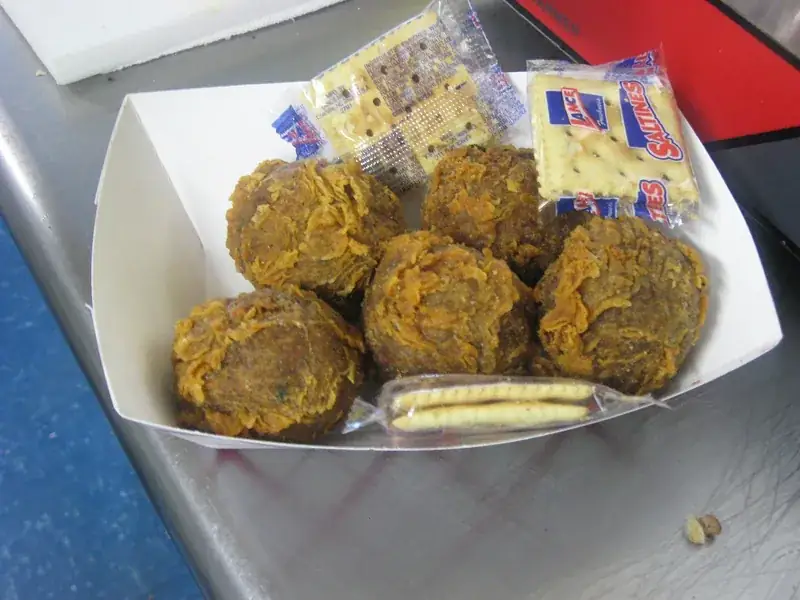
- Boudin: Cajun pork and rice sausage, eaten for breakfast or as a snack in the car.
- Cracklins: fried pork skin and fat, sold warm by the bag at meat markets.
- Po’boy: New Orleans French bread with fried shrimp, oysters or roast beef with gravy.
- Muffuletta: a round Sicilian loaf with salami, ham, cheese and olive salad, born in the French Quarter.
Where to taste the difference
In the French Quarter you can taste the Creole side in a single morning, as on the French Quarter Food Walk. For Cajun food you need to drive west across the Atchafalaya Basin to Lafayette and Breaux Bridge. Our New Orleans and Cajun Country tour does both, with a class in the city where you make your own roux, then a boudin crawl through Cajun meat markets, a crawfish boil in season and a visit to Avery Island, where the peppers for the hot sauce on every table have been grown since the 1860s.
The honest answer
Today the lines blur. New Orleans restaurants serve blackened redfish, a Cajun-style dish invented by a New Orleans chef in the 1980s, and Lafayette cooks put tomatoes in their sauce piquante. The best way to understand it is to eat a bowl of gumbo in the Quarter on Monday and another in Breaux Bridge on Thursday, and then decide which grandmother you agree with.
Questions about Creole and Cajun food
Is Cajun food spicier than Creole?
Often, though most heat comes from the hot sauce on the table, not the pot.
Can gumbo be vegetarian?
Yes. Gumbo z’herbes, made with greens, is a Lenten tradition and can be cooked without meat.